
Colorado built its reputation on opportunity. For decades, the state attracted families, workers, entrepreneurs, and employers who saw a place to build a future. Its mountains and quality of life remain extraordinary, but the economics of living here have changed. Increasingly, the question is not whether people want to live in Colorado. It is whether they can afford to do so.
Housing is at the center of that question. Building homes is difficult even under favorable conditions. Interest rates, material prices, labor availability, and financing costs are formidable obstacles that state and local governments cannot simply decree away. Yet governments do influence other costs, including development fees, land-use restrictions, permitting delays, and construction defect liability. When public policy adds cost and uncertainty to an already difficult business, the result can be fewer projects, fewer attainable homes, and diminished economic competitiveness.
From a Destination State to a State Losing Domestic Residents
The Common Sense Institute reports that Colorado ranked third nationally in domestic migration during 2014–2015 but forty-fourth during 2024–2025. The state lost approximately 12,100 residents through net domestic migration in the latter period, even as international migration and natural population growth helped its overall population continue to increase. Colorado is not literally shrinking, and migration patterns have multiple causes. Nevertheless, the reversal is a warning about the state’s relative attractiveness.
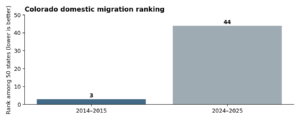
Figure 1. Recreated from Common Sense Institute, “Colorado’s Waning Popularity,” April 20, 2026. Ranking is not a measure of the proportion of departures attributable to housing.
Housing costs are one plausible contributor to that loss of momentum, alongside employment opportunities, taxes, demographics, and other considerations. Whatever the precise contribution of each factor, a state cannot indefinitely rely on its amenities if workers and young families cannot find housing within reach of their incomes.
The Costs Government Cannot Control, and the Costs It Can
No local ordinance can lower the national mortgage rate or reset the global market for lumber, concrete, or steel. Builders also confront labor shortages, acquisition costs, and lender underwriting standards. These are reasons to be especially careful about costs that public officials can influence. Local governments establish development fees, determine permissible density, administer approvals, and decide how predictable and timely their processes will be. The General Assembly establishes much of the legal framework for residential construction liability. Both levels of government have tools that can affect whether housing is feasible.
This is not an argument that every fee is improper or that construction should be exempt from legitimate safety, infrastructure, or environmental requirements. Water systems, streets, schools, and other public facilities have real costs. The question is whether those costs are allocated transparently and proportionately, and whether the cumulative regulatory burden is consistent with the public objective of producing more housing.
Municipal Fees: A Material Cost Before a Home Is Built
A September 2026 Common Sense Institute study examined the taxes and fees associated with constructing the same hypothetical 2,000-square-foot home on a 7,000-square-foot lot in sixteen Colorado cities. Its estimated cost stack ranged from $24,295 in Colorado Springs to $101,616 in Boulder, with an average of $51,732. Denver was approximately $47,376. These are scenario-based estimates, not universal charges for every home.
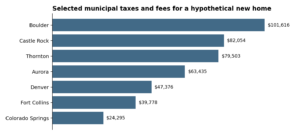
Figure 2. Selected municipalities. Chart recreated from the September 23, 2026 Common Sense Institute fee study. Values represent the study’s standardized development scenario.
Water and sewer system development charges represented a substantial share of these costs in many municipalities. In Thornton, the study identified $57,203 in combined water and sewer charges within a $79,503 total fee stack. The same study reported an average of 210 days for Denver’s major residential development plan review, a timeline that can create additional financing and carrying costs. These figures do not establish that every charge is excessive, but they show why the full cost of local approvals deserves scrutiny.
The study also found that the seven lower-fee cities among fourteen with available permit data issued an average of 13.9 housing permits per 1,000 residents in 2025, compared with 3.1 in the seven higher-fee cities. That association is striking, but it is not proof of causation. Available land, local growth, infrastructure capacity, and other policies also affect production.
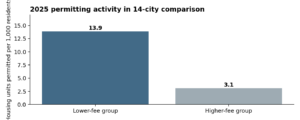
Figure 3. Recreated from Common Sense Institute’s September 2026 analysis. Association does not establish that fee differences caused permitting differences.
The redT Homes Litigation Illustrates the Tension
The litigation brought by redT Homes and redT Capital Partners against Denver illustrates a broader policy tension. The builders challenged Denver’s affordable housing linkage fee and mandatory affordable housing requirements under the Takings Clause. According to the allegations summarized in the federal district court’s March 3, 2026 order, the linkage fees for two proposed four-unit projects were approximately $24,963 and $44,918, respectively.
Denver’s position includes the argument that development generates additional demand for affordable housing and that developers may be required to contribute toward addressing that need. The builders disputed the constitutional validity of the requirements. The district court dismissed the amended complaint without prejudice. That dismissal should not be characterized as a ruling that all development fees are economically wise or that every possible fee structure is constitutional.
Whatever the ultimate legal outcome, the economic question is straightforward: when government requires a builder to contribute to affordable housing, how does that requirement affect the price, financing, and feasibility of the housing the builder proposes to deliver? Affordable housing programs and market-rate attainable housing serve related but distinct needs. Policymakers should measure the effects of their choices on both.
Condominiums: The Missing Rung on the Ownership Ladder
The collapse of condominium construction demonstrates why construction defect liability belongs in this discussion. Condominiums historically provided an ownership option for households unable to afford detached homes. Yet the Common Sense Institute’s March 2026 analysis describes a market in which condominium production remains exceptionally weak while attached rental housing predominates.
The Institute reports that condominium builder liability insurance commonly costs approximately four to six percent of project hard costs, about four and one-half to five times the cost of comparable multifamily rental insurance. It also reports that fewer than five excess-and-surplus carriers were willing to underwrite this risk. Those estimates should be understood as reported market conditions, not premiums guaranteed for any particular project.
Insurance cost is more than an accounting line. It can determine whether a lender will finance a project, whether a developer can offer homes at attainable prices, and whether a builder chooses condominiums instead of rental apartments. The Institute estimates that lowering condominium insurance costs to apartment-development levels could bring approximately 43,000 additional Colorado households within reach of a typical condominium mortgage. That is a modeled scenario, not a forecast of immediate buyers.
Will the New Voluntary Program Actually Change the Risk?
Colorado’s House Bill 25-1272 created a voluntary program intended to encourage multifamily ownership construction through verification, inspection, warranty, and dispute-resolution mechanisms. The legislation acknowledges that construction defect risk can affect condominium production. But acknowledging the problem and changing the economic calculus are different things.
In our earlier article, “New Law, Old Risks: Why Colorado’s H.B. 25-1272 May Backfire on Builders,” we questioned whether the voluntary program would provide sufficiently meaningful protections to justify its obligations. The Common Sense Institute’s March 2026 report likewise describes the effects of the reform as conditional and unproven, and reports skepticism among insurers about whether it will materially change underwriting behavior. That does not establish that the program will fail. It establishes the importance of measuring results rather than legislative intentions.
The relevant questions are practical. Are builders enrolling? Are insurers offering materially improved coverage, premiums, and limits? Are lenders more willing to finance condominium projects? Are permits and starts increasing? And are new units reaching households for whom ownership has become inaccessible? Without improvements in those measures, a statutory program may exist on paper without restoring the missing ownership market.
Competitiveness Requires Action at Both Levels of Government
The state legislature and local governments control different pieces of the problem. Municipalities can review cumulative development charges, increase transparency, simplify approvals, permit appropriate density, and reduce unnecessary delay. State lawmakers can evaluate whether the construction defect liability framework gives homeowners meaningful remedies while allowing builders and insurers to assess exposure with reasonable certainty. Neither can control every economic input. Both can examine the costs and uncertainties their own decisions create.
There are tradeoffs. Reducing fees may require alternative ways to fund infrastructure. Streamlining approvals should not mean sacrificing legitimate safety review. Construction defect reform must address the real interests of homeowners who suffer defective construction. The point is not that every reduction in regulation is beneficial. It is that public officials should evaluate whether a given requirement produces benefits commensurate with its effect on housing feasibility and supply.
Conclusion: Colorado’s Future Is a Choice
Colorado’s housing affordability crisis did not arise from a single cause, and it will not yield to a single solution. Market conditions already make housing difficult to build. Government should therefore pay particular attention to the costs and uncertainty it can influence rather than compound obstacles it cannot control.
Local jurisdictions have meaningful authority over fees, land use, and permitting. The General Assembly can revisit the construction defect framework and determine whether recent reforms genuinely improve the conditions for condominium construction. Neither responsibility can be delegated to the other.
Colorado’s decline is not inevitable. Neither is its continued prosperity. If working families, teachers, nurses, tradespeople, and the children of today’s homeowners cannot afford to live here, the consequences will reach far beyond the construction industry. They will affect employers, communities, and the next generation of Coloradans.
We cannot control every reason housing has become unaffordable. But we can stop making it unnecessarily more expensive. If Colorado intends to recover its competitive momentum, that is a place to start.
Sources and Further Reading
Common Sense Institute, The Cost of Homebuilding in Colorado Cities (September 23, 2026)
Common Sense Institute, Colorado Condos: Is Defects Liability Fixed? (March 26, 2026)
Common Sense Institute, Colorado’s Waning Popularity (April 20, 2026)
Federal district court order, redT Homes v. Denver (March 3, 2026)